


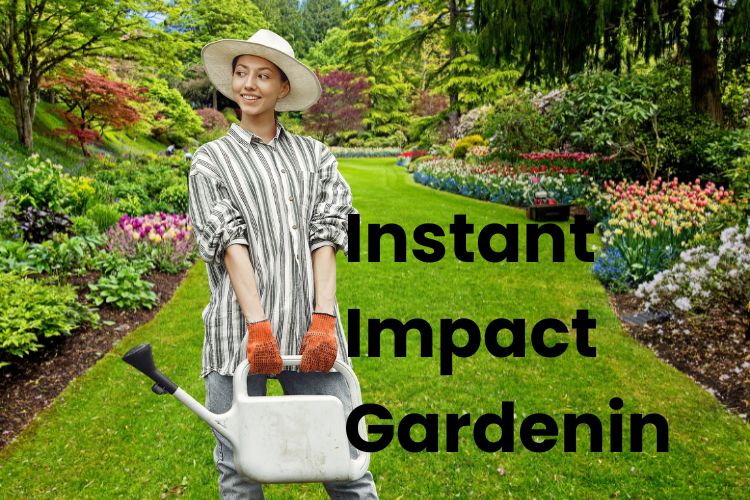
Instant Impact Gardening: How to Make Your Garden Look Established Fast
4th Oct 2026
As gardeners we all need plenty of patience. Plant a small shrub, give it water and a bit of care, then stand back and watch as it gradually develops over the next few years. It's a lovely idea, but sometimes patience is seriously overrated. Let's face it, who can be bothered most of the time?
There are plenty of occasions when you simply don't want to wait years for a garden to mature. Perhaps you've moved into a new house and inherited little more than a patch of grass surrounded by ugly fencing. Maybe you've redesigned an old garden and suddenly discovered just how much empty space you've created. Or perhaps there's one particularly uninspiring corner in your otherwise perfect garden you've been meaning to sort out for years.
That's where instant impact gardening comes in.
The basic idea is very simple and pretty obvious. Use larger, already well-established plants and carefully planned planting combinations to give your garden height, structure, colour, and character from the start.
It doesn't necessarily mean completely filling every available space with enormous plants. Nor does it mean creating a finished garden that will never change. A good instant impact garden still has room to develop and mature.
But what it does mean is that you don't have to wait three, four or five seasons before your garden starts to look like the garden you pictured in your head.
What Is Instant Impact Gardening?
Instant impact gardening is the use of larger, established plants and a coordinated planting scheme to create a mature-looking garden more quickly.
And, to be honest, who wouldn't want that? Just think. Instead of relying entirely on small young plants that may take several years to develop, you use plants which are already mature and at their best.
These might include:
- Established shrubs.
- Extra-large specimen shrubs.
- Mature climbing plants.
- Ready-made border collections.
- Larger evergreen plants.
- Feature plants that create an immediate focal point.
The important word here is some.
You don't need every plant in the garden to be enormous. In fact, mixing larger structural plants with smaller plants that can grow into the available spaces creates a much more natural-looking garden.
Think of the larger plants as the framework of your garden. Once that framework is in place, everything else has something to work around.
Why Do New Gardens Look Empty?
Most new gardens look bare because they lack height, structure and layers of planting. But that only comes with mature, larger plants.
A typical new garden might have a lawn, a patio and perhaps a fence around it. Even when plenty of smaller plants are added, the garden will still look sparse because most of the planting is at the same low level. But, of course, nature doesn't really work like that.
By contrast, established gardens will have several layers, or heights, of plants. There may be taller trees and shrubs at the back, medium-sized plants through the middle of borders, shorter plants towards the front and climbers covering walls or fences.
It's this mixture of heights and shapes that gives a mature garden depth.
If you're starting with an empty garden, introducing a few larger plants can immediately create those missing layers.
What Plants Give the Fastest Garden Impact?
Large shrubs, established climbers and coordinated border plants are among the easiest ways to create immediate impact in a garden.
The right choice depends on what you're trying to achieve. If a border looks empty, larger shrubs can provide structure.
If a fence dominates the garden, an established climber can help soften it.
If you're faced with an entirely empty bed and have no idea what should go where, a ready-made border collection can give you a coordinated starting point.
But before splashing the cash on some mature plants, it's worth asking one very simple question:
What is actually missing from the garden?
Is it height? Colour? Structure? Privacy? Coverage? Or are there simply not enough plants? Once you know the answer, choosing the right type of plant becomes much easier.
Use Large Shrubs to Create the Framework
Shrubs are the backbone of most gardens. They are most effective sitting between small flowering plants and larger trees, providing the permanent shape and structure that holds a planting scheme together.
The problem is that small shrubs can initially disappear into a large border. They may eventually become impressive plants, but that doesn't help you when you're staring at an expanse of empty soil.
This is where established large shrubs become useful.
Because they have already developed more size and shape, they can begin doing their job within the planting scheme from the moment they're planted.
You can use larger shrubs to:
- Anchor the corners of a border.
- Add height behind smaller plants.
- Break up a long stretch of fencing.
- Create repeating structure through a planting scheme.
- Fill awkward gaps.
- Give new borders a more established appearance.
The aim isn't to cram large shrubs into every available space. It's to position them where their additional size will make the biggest visual difference.
When Should You Choose Extra-Large Shrubs?
Extra-large shrubs are particularly useful when you need a strong focal point or have a large empty space that needs immediate structure.
There are times when even a good-sized shrub can feel a little lost. A large new border, an empty corner, or a large empty lawn may need something with a bit more presence.
That's where instant impact extra-large shrubs come into their own.
A large plant will immediately draw the eye and help establish the proportions of the garden.
They can work particularly well:
- At the back of deep borders.
- In prominent corners.
- Beside patios and seating areas.
- As stand-alone feature plants.
- Within larger planting schemes.
- Where a strong evergreen presence is needed.
There's another advantage that isn't always obvious.
Once you establish one or two substantial plants within a border, smaller plants often stop looking quite so small. The eye sees the entire composition rather than focusing on individual gaps.
That can make the whole border feel more mature without every plant needing to be large.
Soften Bare Walls and Fences With Large Climbers
Few things make a new garden feel less established than several metres of brand-new fencing.
You can create a beautiful border in front of it, but if there's still a huge expanse of bare timber behind the plants, the garden can continue to feel unfinished.
Climbing plants solve this by introducing greenery and flowers at a completely different height.
They also make use of vertical space, which is particularly valuable in smaller gardens.
Young climbers are a perfectly good option when you're happy to wait for them to develop. But if the aim is quicker coverage, extra-large climbing plants start with considerably more height and growth already in place.
Large climbers can be used on:
- Garden fences.
- Walls.
- Trellis.
- Pergolas.
- Arches.
They won't instantly cover an entire wall the moment they're planted, and they'll still need time to establish and grow. But starting with a larger plant gives you considerably more to work with from day one.
Just remember that climbers need suitable support. Giving them something secure to grow against and gently training new growth in the right direction will help them develop into the space you want to cover.
Create a Complete Look With Ready-Made Garden Borders
Perhaps the most difficult part of creating a new border isn't planting it. It's deciding what on earth to put in it. You walk around a garden centre or browse plants online and everything looks tempting. Then the questions start.
Which plants work together? Which should go at the back? Will these colours clash? Will everything flower at the same time? Have I bought six plants that will all end up exactly the same height?
This is where ready-made garden border collections can make life much easier.
Rather than choosing every plant individually, a border collection gives you plants selected to work as part of a wider planting scheme.
This can help you introduce:
- Different plant heights.
- Complementary colours.
- Variation in foliage and texture.
- Seasonal interest.
- A more coordinated appearance.
This is exactly what you want when you are filling a completely new border and aren't confident about designing a planting scheme from scratch.
You still get to do the enjoyable part: planting everything and watching the border grow and flourish. But much of the difficult plant selection has already been done for you.
Start With Structure, Then Add Colour
One of the easiest mistakes to make when filling an empty garden is buying plants simply because they're flowering beautifully on the day you see them.
We've all done it.
The result can be a haul of wonderful plants that somehow don't make much sense when they are delivered to your door.
For an instant impact garden, it's usually better to think about structure first and colour second.
Start by deciding where the main plants will go.
These might be:
- A large evergreen shrub.
- Two or three established flowering shrubs.
- A mature climber against a fence.
- A feature plant near a seating area.
Once those larger shapes are in position, you can add flowering shrubs, perennials and smaller plants around them.
Suddenly you're not trying to fill a blank space. You're filling the spaces between an existing framework.
It's a much easier way to design a garden.
Think in Layers Rather Than Individual Plants
A mature garden rarely looks good because of one spectacular plant. It works because lots of plants occupy different levels.
A useful way to think about planting is in layers:
- Upper layer: trees, tall shrubs and climbers.
- Middle layer: established shrubs and larger perennials.
- Lower layer: compact shrubs, perennials and flowering plants.
- Front and ground layer: low-growing and ground-cover plants.
You don't necessarily need all four layers in every border, but thinking vertically will prevent all the plants sitting at the same height.
This is especially important in smaller gardens. Growing upwards with climbers and taller planting can often make better use of the available space than simply adding more and more plants at ground level.
Can You Make a Small Garden Look Established Quickly?
Yes. In a small garden, a few carefully chosen established plants can create more impact than a large number of smaller plants.
It's tempting to assume that instant impact gardening is only suited to large gardens. Actually, it can work brilliantly in compact spaces. The trick is restraint. Don't go over the top.
You don't want to fill a small garden with plants that will eventually overwhelm it. Instead, choose a limited number of larger plants whose eventual size suits the space.
A well-positioned established shrub can become a focal point. A climber can add height without using much ground. A nicely planned border can provide plenty of interest without needing dozens of different varieties of plants.
In a smaller garden every plant is more visible, so choosing fewer plants well can be far more effective than simply choosing more plants.
Can You Create an Instant Impact Garden on a Budget?
The best way to create instant impact on a limited budget is to spend more on a few important structural plants and use less expensive smaller plants around them.
Larger, well-established plants do cost more than smaller shrubs, but you certainly don't need an entire garden full of mature specimens. Choose the parts of the garden where size will have the biggest effect.
For example, you might invest in:
- One substantial shrub for an empty corner.
- A larger climber for the main fence.
- Several established shrubs to form the backbone of a border.
Then use smaller, less expensive plants around them. Over time those smaller plants will mature, while the larger specimens prevent the garden from feeling empty in the meantime.
This combination of plant sizes is often more convincing than attempting to make absolutely everything instant.
Don't Forget Evergreen Structure
Most of us are guilty of thinking mostly about blooms and flowers, especially when we're choosing plants during spring and summer. But if you want a garden to look established throughout the year, foliage matters just as much.
Evergreen shrubs provide permanent shape even when other plants have died back or lost their leaves.
Including some evergreen plants within your main structure can stop a garden appearing completely bare during winter.
That doesn't mean everything needs to be evergreen. A combination of evergreen and deciduous plants usually gives a more interesting result.
The evergreen plants provide the framework while deciduous shrubs and flowering plants bring seasonal changes.
Give Large Plants Room to Grow
This is possibly the most important rule of instant impact gardening.
Large plants are already established, but they haven't finished growing.
It's easy to look at an empty border and position plants close together because you want every gap filled immediately. Don't be tempted.
Check the expected mature size of each plant and allow reasonable space for future development.
If you plant everything too closely, the garden may look fantastic initially but become overcrowded later. You can fill temporary gaps with smaller plants, seasonal planting or containers while permanent shrubs develop.
Instant impact should give you a head start, not create problems a few years down the line.
Do Larger Plants Still Need Time to Establish?
Yes. An established plant gives you more size immediately, but its roots still need time to settle into their new position.
Larger plants aren't an excuse to forget normal planting care.
After planting:
- Water thoroughly.
- Keep an eye on soil moisture during dry weather.
- Make sure climbers are securely supported.
- Mulch where appropriate.
- Avoid unnecessary feeding immediately after planting.
- Allow the plant time to settle.
A large plant may look as though it has been in your garden for years, but underground it is still adjusting to a completely new environment.
Giving it a good start will help ensure the instant impact you bought continues for many years.
Instant Impact Doesn't Mean Instant Perfection
There's an important difference between an instant impact garden and an instantly finished garden.
As we all know, gardens are never really finished. No matter how long we work in them.
Plants grow. Borders change. Some plants thrive more than expected while others decide they don't like the position you've chosen for them at all. That's part of the fun.
Instant impact gardening simply allows you to skip some of the emptiest early stages.
You get structure sooner.
You get height sooner.
You get a more established appearance sooner.
But you still get to watch the garden evolve.
And that's surely the best of both worlds.
A Simple Formula for Creating an Instant Impact Garden
If you're faced with a blank canvas of a garden and aren't sure where to begin, keep things simple.
- Identify the emptiest areas.
Look for bare borders, exposed fences and corners that lack structure. - Add your main structural plants.
Use established or extra-large shrubs where you need height and presence. - Use climbers vertically.
Soften fences, walls and garden structures with established climbing plants. - Build borders around the structure.
Use coordinated planting or ready-made border collections to introduce colour, texture and different heights. - Include some evergreen plants.
This will give the garden structure beyond spring and summer. - Leave room for growth.
Remember that even established plants will continue getting larger. - Be patient — just not quite as patient.
The garden will still improve year after year, but you won't have to stare at empty soil while you wait.
Is Instant Impact Gardening Worth It?
For many of us, it's a resounding yes.
It can be particularly worthwhile if you've moved into a new property, redesigned an existing garden or simply reached the stage of life where waiting ten years for a shrub to become impressive doesn't sound particularly appealing.
But you don't need to replace traditional gardening with instant gardening. Use both.
Allow some plants to start small and mature naturally. Enjoy watching them change over the years. But where the garden needs immediate structure, height or colour, there's absolutely nothing wrong with giving nature a head start.
After all, gardening should be enjoyable. And sometimes it's nice to walk outside, look at what you've planted and think:
That's already starting to look like a proper garden.
Explore Plants for Instant Impact
At Direct Plants you'll find plenty of options for creating a more established garden without waiting years for every plant to mature.
You can explore our ready-made garden border collections for coordinated planting schemes, choose from established large shrubs for greater structure, make a stronger statement with our instant impact extra-large shrubs, or introduce height and faster coverage with extra-large climbing plants.
Whether you're starting with a completely blank garden or simply filling an awkward gap, choosing a few more established plants can make an enormous difference to how quickly your garden begins to feel like your own.