


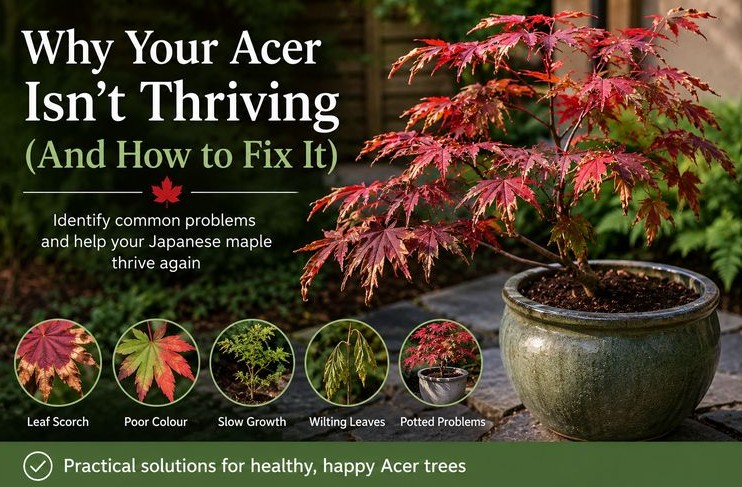
Why Your Acer Isn't Thriving (And How to Fix It)
15th Jun 2026
You know the feeling. You've bought a new plant or tree, you're so excited at getting it planted and can already see in your mind's eye how it will look when well-established and thriving. But then you wait and you wait... It can happen with any plant but, as I'm a huge fan of Acers, I have to say there are few things more disappointing than planting a beautiful Japanese maple, standing back to admire your handiwork, and then watching it slowly fail to live up to expectations.
A few things can happen to spoil your enjoyment of your recently planted Acer. Perhaps the leaves are turning brown around the edges. Maybe the foliage isn't as colourful as you hoped. Or perhaps the tree simply seems to be sitting there with nothing happening. Any of these things can spoil the enjoyment we take from watching a Japanese maple grow and thrive in our garden.
The good news is that if your Acer is struggling it's not the end of the world and most problems can be easily fixed. Many of the issues that gardeners experience with Japanese maples are surprisingly, and gratifyingly easy, to identify and correct.
So, before you panic and reach for the spade to dig up the offending plant and consign it in disgust to the compost heap or recycling bin, let's look at some of the most common reasons Acers struggle and, more importantly, what you can do to fix them.
First Things First: Is Your Acer Actually Struggling?
With Acers it's often slow and steady wins the race. After all, one of the first things we learn about Japanese maples is that they are not particularly fast-growing trees.
Many plants and trees naturally grow slowly, especially during their first few years after planting. And that can certainly be true of Japanese maples. A newly planted Acer may spend much of its energy establishing roots rather than producing lots of new top growth.
So, if your Acer isn't shooting upwards like a Leylandii, don't worry. That's perfectly normal. However, if you're seeing damaged leaves, poor colour, or obvious signs of stress, there will be an issue beyond a slow growth habit.
Brown Leaf Edges (Leaf Scorch)
This is probably the most common Acer complaint of all. The symptoms are usually easy to spot:
- Brown, crispy leaf edges
- Dry-looking foliage
- Leaves curling slightly
- Damage appearing during summer
Most gardeners immediately blame the sun. Sometimes they're right. But surprisingly often, wind is the real culprit. Which sounds bizarre but strong winds can dry out the tree’s delicate leaves faster than the roots can replace the moisture.
This is one reason why positioning matters so much. If you haven't already, our guide on where to plant a Japanese maple explains how to choose a sheltered location.
How to Fix It
- Water during prolonged dry spells
- Mulch around the base to retain moisture
- Provide shelter from prevailing winds
- Avoid moving the tree unnecessarily
Once conditions improve, healthy new growth will more than likely appear in the following season.
Poor Autumn Colour
One of the main reasons people plant Acers is for their spectacular autumn display. It can be frustrating when your tree turns a mucky shade of brown instead of producing those fiery reds, oranges, and golds you've been dreaming about.
Several factors can affect autumn colour:
- Too much shade
- Stress caused by drought
- Poor soil conditions
- Unusual weather patterns
It's also worth remembering that different varieties naturally produce different autumn colours. If you're still choosing a variety, our guide to the best Japanese maple varieties may help you find one with exceptional seasonal colour.
Leaves Turning Green Instead of Red
This can often cause concern for us gardeners, particularly with red-leaved Acer varieties.
While some varieties maintain their colour throughout the growing season, others will become greener during summer before colouring up again in autumn. However, too much shade can also reduce red pigmentation.
How to Fix It
- Check whether the variety naturally changes colour (in which case you’ve got nothing to worry about)
- Ensure the tree receives enough light
- Avoid planting in deep shade
The aim isn't to expose your Acer to full blazing sunshine all day, but to strike a nice balance between light and protection.
If you're unsure how sunlight behaves in your garden, our guide to plants for sun, shade, and everything in between can help.
Your Acer Isn't Growing
No-one wants this do they? If your Acer seems stuck in the same place year after year, several factors could be responsible.
Common causes include:
- Poor soil conditions (number one reason and the most common)
- Waterlogged roots
- Lack of moisture
- Excessive competition from nearby plants
- Insufficient sunlight
Japanese maples generally prefer well-drained soil that retains some moisture without becoming saturated. If you're unsure whether your soil could be causing problems, our guide to understanding your soil can help you identify potential issues.
Drooping or Wilting Leaves
Few things make gardeners panic faster than a wilting plant. Fortunately, temporary wilting doesn't always mean disaster. Many plants will go through this trauma.
During hot weather, Acer leaves can droop simply because the tree is trying to conserve moisture. Check the soil before doing anything dramatic.
If the soil is dry:
- Water thoroughly
- Apply mulch
- Monitor moisture levels during hot spells
If the soil is already wet, overwatering may actually be the problem.
Problems With Acers in Pots
Container-grown Acers face a few additional challenges. Because they have less soil available, pots dry out more quickly than garden borders. Roots are also more exposed to temperature fluctuations.
Common container issues include:
- Dry compost
- Root restriction
- Nutrient depletion
- Winter frost damage
If you're growing an Acer in a container, our guide to growing Japanese maples in pots covers these challenges in more detail.
Sometimes the Problem Is Simply the Wrong Location
This is probably the biggest lesson most Acer growers eventually learn.
A healthy Acer planted in the wrong place will often struggle.
A healthy Acer planted in the right place will usually thrive with very little intervention.
Before reaching for feeds, treatments, or miracle cures, ask yourself:
- Is it sheltered?
- Does it receive suitable light?
- Is the soil draining properly?
- Does it have enough space?
Very often the answer lies there.
Prevention Is Better Than Cure
Most Acer problems can be avoided before they start.
The key is choosing:
- The right variety
- The right location
- The right growing conditions
If you're new to Japanese maples, it's worth reading our complete guide to Japanese maple trees for UK gardens, which brings together everything you need to know about selecting, planting, and caring for Acers.
Final Thoughts
Japanese maples may look delicate, but they're often far tougher than people give them credit for. Most problems come down to a handful of common issues such as wind exposure, unsuitable soil, incorrect positioning, or temporary drought stress.
The good news is that once these issues are identified, Acers often recover remarkably well. With the right conditions and a little patience, your Acer can become one of the most rewarding and eye-catching plants in your garden.
Explore Our Range of Acer Trees
Whether you're looking for a compact Acer for a patio, a dramatic red-leaved specimen for a border, or a graceful laceleaf variety as a focal point, you can browse our full range of Acer trees on the Direct Plants website.
With a wide selection of Japanese maples available, there's an Acer to suit almost every garden, whatever the size or style.